Cutting deep scratches out of hard paint with wool
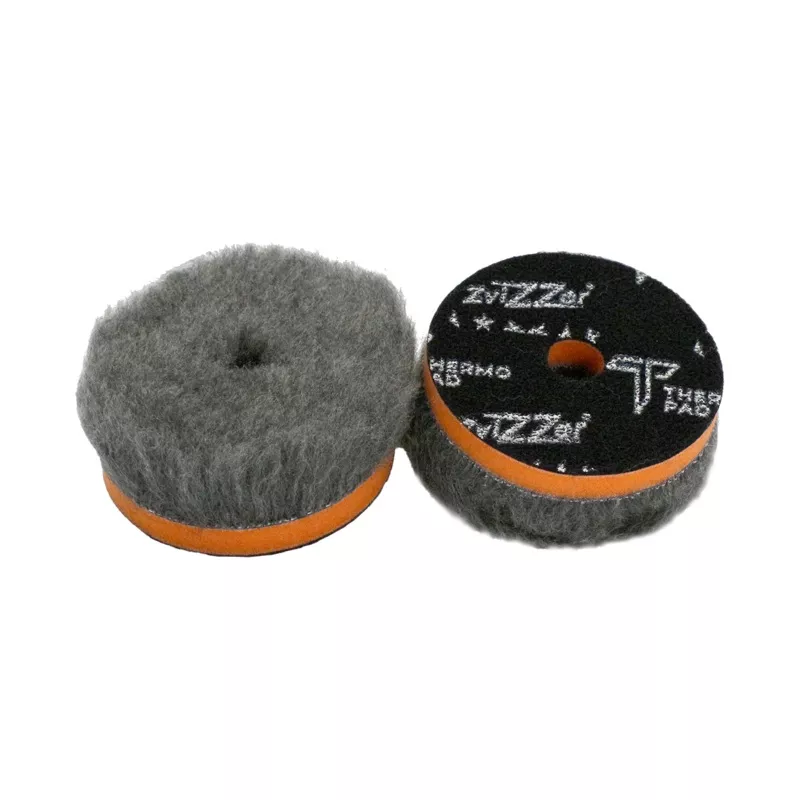
What is the ZviZZer Thermo Nano Wool Pad? A wool pad made from real natural wool on an open-cell thermo foam with a hook-and-loop back that cuts deep scratches and sanding marks out of hard clear coat on a rotary. The wool cuts harder and cooler than foam, and the thermo core pulls the friction heat away. Not for the swirl-free finish, and not for soft, delicate paint.
The ZviZZer Thermo Nano Wool Pad is a wool pad from ZviZZer made of real natural wool fibre on an open-cell thermo foam core, run in the material system under the system colour orange. Unlike a foam pad, the wool fibre cuts harder under rotation and builds up less heat doing it, because the fibre tips slice instead of rub. The 25 mm thermo layer keeps its distance from the surface and carries the heat away, so the cut stays high over the pass while the paint stays cooler.
- Wool cuts cooler than foam. The slicing natural fibres pull more defect out of hard clear coat than a foam pad of the same size, and heat the panel less while they do it. That way you correct weathered or scratched paint faster, without cooking the thin clear coat only about 40 to 50 microns thick in one spot.
- Three sizes from 80 to 160 mm. With 80, 130 and 160 mm you cover every panel from the bumper to a full door. The 25 mm thermo layer gives the wool distance from the backing plate and carries the heat off, which gives the pad a long life.
- High cut for heavy correction. The Nano Wool Pad is the strongest cutting grade in the ZviZZer pad line-up. Paired with a heavy-cut polish like the HC 4000, the duo pulls deep scratches and sanding marks from P1500 grit and up the kind a foam pad never gets near.
Detailing1’s tip from the shop: The most common mistake with a new wool pad is laying it down dry and unprimed. Fresh wool sheds loose fibres on its first run and drags them across the paint instead of cutting. Brush the pad out by hand or with a pad brush before the first job, and prime it with a bit of polish. We had a weathered, chalky bonnet run clean in a single pass with the brushed 160 mm pad, while the unbrushed one just left wool lint behind.
Cutting the scratches off on the rotary with a heavy cut
Put a pea-sized blob of cutting polish on the wool pad, spread it at low rpm, then work it at medium rpm with steady pressure until the scratches drop out of the paint.
The Nano Wool Pad is built for the rotary, where the wool brings its full cutting power. The catch is a clean, decontaminated surface, or a grit particle under the fast-spinning wool will drag deep scratches. Pair it with a strong HC 4000 cutting polish, whose red heavy-cut grade is matched to the high removal of the wool. Keep the pad moving and work in passes.
Keep the wool clean: after every panel, brush the polishing dust out or swap to a fresh pad, because matted, clogged wool just smears and stops building any cut. After the job, rinse it in lukewarm water and dry it flat ZviZZer recommends a microfibre detergent for that, around 50 ml per load at 30 to 60 degrees.
Heavy correction yes, the final finish no
The Nano Wool Pad is the cutting grade for deep defects: oxidised and scratched clear coats, sanding marks after wet sanding and chalky panels all come out with the right cutting polish for the last high gloss the fibre is too coarse.
Its home turf is the first, heavy correction stage, where a foam pad cuts too little. On a bonnet bleached out in the sun, the wool slices the dead paint layer off and frees up deep gloss, while the thermo layer keeps the heat in check. The open fibre holds the cut steady across the whole panel.
The limits are honest: a wool pad doesn’t finish. It leaves a coarser cut that you then have to refine with a finer grade, or holograms stay in the paint. When you need maximum cool cutting, reach for the wool. When a swirl-free finish has to follow, go after it with the softer Thermo Velour Pad and a finishing polish. On soft Japanese clear coats or fresh smart-repair paint the wool is too aggressive there you grab a foam pad.
For the correction polisher, not the refresher
The Nano Wool Pad is the right call when you’re cutting deep defects and you want a pad that cuts fast while keeping the paint cooler than foam.
Because it’s the strongest grade in the stepped ZviZZer pad system, it sits at the start of the polishing path and is part of our polishing pads and sanding sponges. It doesn’t replace the foam pad it opens the correction: you do the coarse cut with the wool and the refining afterwards with foam or velour. That way no defect stays sitting under the gloss to surface again at the next wash.
It’s less suited to the occasional refresher who only wants to freshen up tired paint, and to delicate soft paints. As the successor to the well-known Doodle wool pad, the Nano Wool fibre belongs to the pro class that bites hard. If you only want to take out light swirls, you’re better off with a microfibre or foam pad and a one-step polish.
The one point most people underrate: with a wool pad you control the cut through polish and pressure, not by pinning the rpm to the stop. Full rpm on dry or clogged wool just makes heat and lint, not more cut. Keep the wool clean, pair it with the right cutting polish and run it in passes with steady pressure, and you’ll pull the full cool cut out of a single pass which is exactly what the Nano Wool fibre is built for.