Universal cleaner for cars: Teufels-Reiniger, the alkaline answer to grease, oil and nicotine film
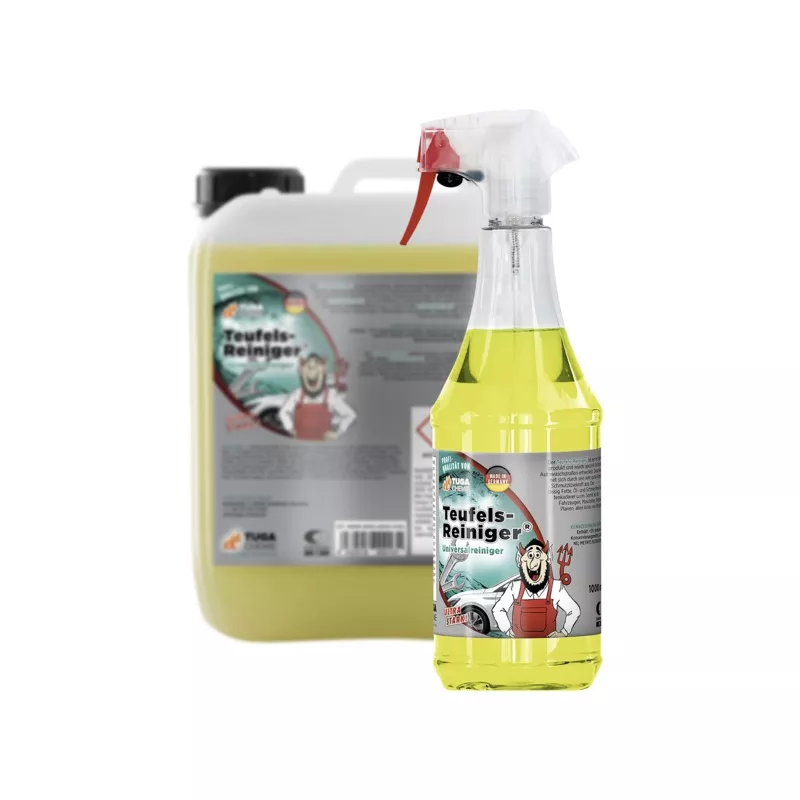
What is the Teufels-Reiniger? A highly alkaline universal cleaner from TUGA Chemie GmbH with a pH of 10.5 to 11.8 built to saponify organic fats, oils, nicotine film and diesel soot. The formula runs on tetrapotassium pyrophosphate as the sequestrant, sodium alkane sulfonate as the anionic heavy-duty surfactant, trideceth-9 as the non-ionic co-surfactant and sodium metasilicate as the alkaline builder. Dilutes up to 1:10, ready to use in the 1 L bottle. Keep dwell time strictly under 3 minutes metasilicates that dry on the surface burn it permanently (“APC spots”). Strictly off-limits for genuine leather, Alcantara, unprotected aluminium and hot glass fibre.
Teufels-Reiniger is the industrial all-purpose cleaner from TUGA Chemie GmbH, and it sits like a sledgehammer between consumer convenience and brute-force industrial chemistry. The formula is built on a classic, hard-hitting APC profile: tetrapotassium pyrophosphate binds the calcium and magnesium ions in your wash water (water softening), sodium alkane sulfonate brings the primary cleaning power against heavy oils, trideceth-9 emulsifies even at low temperatures, sodium metasilicate buffers the pH for steady cleaning performance, and sodium polyacrylate keeps the dissolved dirt particles in dispersion.
TUGA Chemie from Osnabrck has been making these formulas in Germany for decades and supplies commercial detailers, workshops and serious private customers across the DACH region.
The mechanism works in four phases. First, the alkane sulfonates drop the surface tension of the water, so the solution wets the dirt completely. Second, the highly alkaline environment (buffered by sodium metasilicate) attacks the ester bonds in organic fats and splits them by saponification into water-soluble soaps and alcohols. Third, the surfactants latch onto the non-polar soot and oil particles and form micelles that wrap the dirt up. Fourth, the polyacrylates and pyrophosphates stop the micelles from re-clumping the dirt lifts off and rinses away clean with plain water.
This architecture is tuned specifically for aliphatic hydrocarbons engine-oil splatter, chain grease, diesel soot, nicotine residue, brake-oil leaks. For purely inorganic dirt like limescale or rust an acidic cleaner does a better job; that is not what the Teufels-Reiniger is for.
- Dilutes up to 1:10 the most economical option in the pro range. Ready to use in the 1-litre bottle (around 11 EUR), neat for extreme cases, 1:1 to 1:5 for medium industrial grime, 1:10 for light all-round jobs. A 5 L canister at 1:10 gives you 55 litres of working solution the cost per litre of working solution drops to about 60 cents.
- Saponification instead of scrubbing. The high alkalinity (pH 10.511.8) splits fat molecule chains chemically what takes hours of brushing with pH-neutral cleaners, the Teufels-Reiniger pulls off in two to three minutes of dwell time. On shop floors soaked with old oil, machine frames black with brake dust and engine-bay aluminium gummed up with insect resin, this is the go-to method.
- 11 EUR per litre in the 1 L bottle, 7 EUR in the 5 L canister. Direct rival Koch-Chemie Green Star (concentrate 1:30, ~7-9 EUR/L) is cheaper per litre of concentrate but needs a separate mixing bottle. Sonax Profiline MultiStar (12-20 EUR/L concentrate) sits above it. GYEON QM APC (14-25 EUR/L concentrate) is the premium boutique pick. Soft99 Wash Mist (36-46 EUR/L) is a cockpit specialist with antibacterial action not a heavy-duty rival. Dr. Wack A1 (~14-32 EUR/L) is a care detailer without the brute dissolving power.
Detailing1s tip from the shop: Day-to-day, most of the APC spots we see come down to exactly one mistake: customers let the Teufels-Reiniger dwell longer than 3 minutes because they figure “longer is better”. It is the exact opposite the moment the water evaporates, the metasilicates and pyrophosphates crystallise as solid caustic on the surface. Those are the milky-white spots that suddenly show up in raking light, and the only way back is machine paint correction with a heavy-cut polish (cut factor 8/10 to 10/10 on a medium-hard microfibre cutting pad). A stopwatch is a must, not a gut feeling. On top of that: on a black bonnet sitting at 60 degrees, that 3-minute window shrinks to 30 seconds. Never work in the sun, always pull the car into the shade that is not optional, that is damage prevention.
Dilute, spray on, wait three minutes, wipe off or rinse.
The standard workflow starts with dilution despite the ready-to-use look of the 1-litre bottle, it pays to thin the product for light and medium dirt. The rule of thumb: 1:1 for heavily greased engine-bay parts and shop floors, 1:5 for plastic trim and headliners, 1:10 for standard interior cleaning and door rubbers. Decant into an empty spray bottle, top up with distilled or low-lime water, give it a quick shake.
The surface has to be cool never in full sun, never on hot brake discs, never straight after the engine has run. In direct sunlight, move the car or the part into the shade. For shop work in summer, hit the floor in the morning or evening, when the concrete is cool.
Spray the cleaner on evenly from 20 to 30 centimetres away. On vertical surfaces, work from the bottom up to avoid concentration gradients and run marks. Let it dwell three minutes strictly no longer. On heavily crusted spots (baked-on bug splatter, old nicotine film), agitate during the dwell time with a soft brush or microfibre pad, no pressure.
Then rinse off clean or wipe down with a damp microfibre cloth. For outdoor work, neutralise thoroughly with plain water or a pressure washer. For interior work you absolutely need a second, clean and slightly damp microfibre cloth the alkaline surfactant residue has to come off, or you get streaks over time.
In the shop, the Teufels-Reiniger is often the prep stage before paint care. Lay wax or sealant on without degreasing first and the care product only bonds loosely durability collapses. First the Teufels-Reiniger at the right dilution, then a pH-neutral car shampoo as a neutralising wash, then the protection.
Engine bay, wheels and shop floor yes. Genuine leather, Alcantara and aluminium no.
The Teufels-Reiniger is cleared for painted body panels (cold!), wheels of clear-coated aluminium or steel, engine-bay plastics and rubbers, concrete shop floors, tiled areas, machine frames with clear-coat protection, truck tarpaulins, plastic garden furniture and heavily greased kitchen surfaces. The official manufacturer clearance for industrial use makes the Teufels-Reiniger a crossover product between detailing and workshop supply.
Four material groups are strictly out. First, genuine leather and Alcantara: the alkaline hydrolysis destroys the natural oils in the collagen fibres, which over time leads to cracking and embrittlement. Use pH-neutral cleaners made for leather not a highly alkaline APC profile.
Second, unprotected or anodised aluminium: the strong alkalinity attacks the protective oxide layer, showing up as dull or whitish patches. Polished aluminium wheels with no clear-coat protection are off-limits, and so are aluminium trim strips on older cars without a seal.
Third, hot glass fibre and carbon-fibre-reinforced parts: the surfactant solvents can loosen resin-adhesive bonds on visible carbon parts with damaged clear coat, keep a safe distance or mask off first. Fourth, touchscreen displays with anti-reflective coating: the alkaline surfactants attack the oleophobic layer irreversibly.
One important field note: on newer VAG soft-touch surfaces (rubberised buttons and switches in the Golf VI, Audi A4 B8 or older), the glycol-ether content makes them swell and leaves a tacky finish. No problem on modern hard plastics; with soft-touch, test discreetly first.
Spring detailing, peak bug season and the industrial use case.
Demand for universal cleaners in the DACH market tracks the Central European weather cycle closely. The first peak lands in spring detailing between March and May, when road-salt corrosion on suspension and wheel-arch liners, winter grime in the engine bay and grit-grease residue on shop floors all have to be dealt with at once. The second peak is in early summer (May to July), when insect resin, pollen glue and tree sap become the main cleaning job workshops and mobile detailers order 50 percent more in those weeks than in winter.
The 1-litre spray bottle at around 11 EUR is the easy way in for a single car in a private household with some workshop needs degrease wheels before sealing, clean the engine bay before care, treat oil stains on the garage floor right away. Used quarterly at 1:5 dilution, a 1-litre bottle lasts about two years.
The 5-litre canister at around 33 EUR saves about 35 percent per litre and is the standard size for workshops, mobile detailers, engine tuners and bigger private garages. With weekly shop use, that is a three-to-six-month supply per litre of working solution at 1:10 dilution it works out to about 60 cents, a clear efficiency win over ready-to-use rivals.
Off-label, the Teufels-Reiniger has made a name as an industrial all-rounder. Manufacturer clearance officially covers truck-tarpaulin cleaning, cement floors in warehouses and machine parts in metalworking the high pyrophosphate concentration cracks even dried-on machine-grease residue. On the detailing forum dasdetailingforum.de it gets traded around as the “quiet workshop standard” that covers DIY needs alongside car care.
Safety note: the product is classified as eye-irritant (H319). When using it, safety glasses and nitrile gloves are a must. As a water-based product the VOC content is marginal ventilation in closed spaces is recommended, but no professional extraction is needed. Proper disposal goes via the waste code for alkaline lyes not down the household bin or the regular drain. On skin contact, rinse off thoroughly with water at once.
Goes well with: Universal cleaners in the range Tugalan concentrate (5 L for the shop) Kunststoff-Teufel (interior version)